
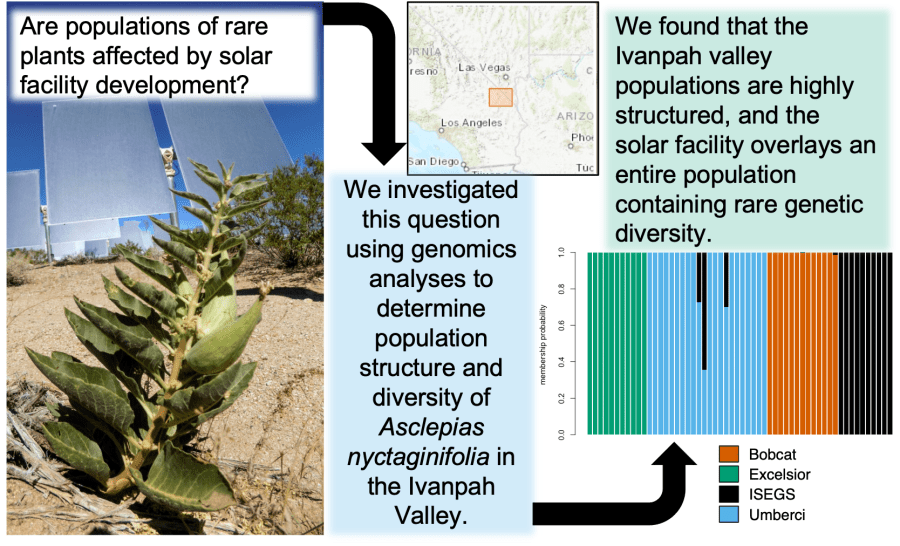
I (and coauthors!) recently published the first chapter of my dissertation. Here is a short summary of the work we did and our findings! I used ChatGPT to generate the basic summary and then went through and made edits. I highly recommend this!
Get to know the study system
Desert ecosystems, known for their high solar energy potential, have seen increased development of large-scale solar energy facilities, such as the Ivanpah Solar Electric Generating System (ISEGS) located in the Mojave Desert of Southern California, USA. While solar energy is efficient, it can have significant ecological impacts on these already vulnerable ecosystems. These impacts include changes in wind patterns, shade, hydrology, plant distribution, and herbivory/pollination patterns. Solar energy development can lead to habitat disruption, increased fire risk, soil erosion, and hindered plant succession.

Despite the growing importance of solar energy, there’s limited understanding of its ecological effects on desert plant populations. Desert plants often rely on specific climatic conditions for reproduction and face challenges in recovering from rapid environmental changes. To ensure the environmental sustainability of solar energy facilities, it’s essential to understand their impacts on plant populations. Furthermore, there’s a lack of genetic information about desert plant populations, making it difficult to inform solar energy facility development and conservation efforts. This genetic information is crucial for understanding population structure, local adaptation, and unique genetic diversity within populations.
The Mojave Desert, a hotspot for solar energy development, is home to diverse and environmentally sensitive plant species. However, the desert faces increasing anthropogenic change, and understanding how this affects plant species diversity is vital. Our study focused on Mojave milkweed, an endemic and threatened plant species found in the Mojave Desert. The Ivanpah Valley, home to ISEGS, provides insights into how solar energy development affects rare plant populations. We aimed to address key questions about the population structure and diversity of Mojave milkweed in the Ivanpah Valley.
Our findings and key takeaways
Genetic Diversity and Structure: We found that Mojave milkweed populations in the Ivanpah Valley are highly structured, with each population exhibiting unique genetic variation. There is evidence of some recent gene flow between the ISEGS and Umberci populations, likely due to their closer proximity and wind-dispersed seeds. The ISEGS facility houses a genetically distinct population of Mojave milkweed. This population’s central location, the presence of private alleles, and low pairwise genetic distance values indicate that ISEGS serves as a source of rare genetic diversity for Mojave milkweed in the region (See below). We also found that Mojave milkweed populations have small effective sizes (Ne) below the 50/500 rule thresholds for short-term and long-term genetic viability. Small Ne values make these populations susceptible to inbreeding depression, reduced genetic diversity, and genetic drift, which can lead to genetic erosion.
This figure summarizes a method of visualizing population structure. Within the network, the circles that are closer to one another are more genetically similar than those that are farther away. The ISEGS individuals are located centrally, suggesting that they contain variation that is ancestral to the other populations. The populations’ ancestral position is further supported by some individuals that were sampled from other populations clustering closer, based on genetic distance, to ISEGS samples than their putative populations.

Implications for Solar Energy Development: The ISEGS facility’s presence over the genetically distinct Mojave milkweed population underscores the importance of protecting this population. The study also raises concerns about the facility’s impact on hydrological patterns, herbivory, and habitat fragmentation, which could further reduce genetic variation and disrupt local genetic structure. The study emphasizes the need to consider the population structure and genetic health of rare and imperiled species when designing large solar energy facilities. Creating protective zones (halos) around genetically distinct populations can be beneficial, but potential impacts on habitat and genetic diversity should be thoroughly studied. The importance of aligning renewable energy goals with biological conservation cannot be overstated. Future solar energy projects should take into account the genetic diversity and population structure of species in the area to minimize negative ecological impacts.
 'Omics in the Anthropocene
One thought on “Of Mojave Milkweed and Mirrors: a tale of solar energy production and plant populations”